I love the #oneword initiative, and one of the best parts of it is reflecting on your previous word. So, before I talk about this year's word, a quick note on the last. Looking back on 2018, when my #oneword was "In", I'm not sure if I met all of my goals for that word. I selected "In" because I was frustrated with the lack of leadership within our country, with the respect (or lack thereof) social studies education was receiving, and with the test-driven culture being cultivated in our schools. My stated goals were to remain active in the educational community by leading professional development, being active on Twitter, and forging links with other educators. In addition I had hoped to push for more respect for social studies ed, and seek out alternative methods for assessment beyond tests. For the first goal, Twitter has been a godsend. There are so many teachers that I have learned from and built connections with, and I've met very few of them face to face. I was actually offered a second teaching position from a connection I had made through Twitter, and am loving the opportunity that I have had to work with students from all over the country through this opportunity! But, unfortunately, I haven't had the chances to lead as much professional development as I had hoped, but will strive to work towards more opportunities in 2019. I am excited about how testing has become much less of a focus in our classroom. As I've written about in previous posts, I have begun working with much more student choice and assessment based on what I call "justifiable dialogue", and have been pleased with the results. I'm definitely looking forward to growing this in the next year!
Now on to 2019. When I consider my #oneword each year, I generally begin the process by laying out goals for the upcoming year. Once laid out, I study those goals to see if a pattern or connection emerges, and that is often where my word emerges. After laying out my goals for this year, the connective word became abundantly clear.
My #oneword2019 is LEARN!
Teachers lose something when they believe they have nothing left to learn. When I retire, I hope there are many things I have left to learn. My stated goals for the year are
to lead and/or attend at least 5 professional development opportunities
to pursue the chance to take classes to expand my knowledge base
to read at least 10 books in my field (my goal is 20 total counting books read just for pleasure; hats off to those of you who read 50 or more, I just don't have time)
to continue using Twitter as a means of working with other teachers from around the world
and to continue seeking out ways to grow student voice and to always be willing to listen, as I often learn a great deal from my kids.
I had the great privilege recently of moderating a #sunchat that focused on the "Power of Why", drawing inspiration from the great principal, Baruti K. Kafele, who said "If you have lost your way, it is probably because you've lost your why."
A great discussion topic to be sure, as the "why" for every teacher is the root of what every teacher should constantly keep at the center of everything they do. Countless teachers emerge from colleges across the country every year, ready to tackle their first year of teaching, their first classroom, with an infectious optimism and an unfailing belief in their ability to make a truly positive impact in every student who will walk through their doors. That was me. The reality of education is harsh though. On a daily basis, teachers can expect to face a myriad of obstacles, ranging from inadequate facilities and/or resources, students who just won't engage, frustrating administrators, frustrating colleagues resistant to growth or change, angry parents, mounds of paperwork, mounds of grading....the list goes on and on. When one sees these frustrations it may seem clear why teachers burnout, why teachers leave the classroom in pursuit of something else. Teachers who have lost their spark.
I don't say that to judge in any way. Any teacher who claims that they haven't had those moments when they feel like they've reached the end of their educational rope are likely kidding themselves. I love teaching, it is one of the great passions of my life, I can't imagine doing anything else...but I have had my fair shares of ruts and low points, bad experiences that have found me questioning my way. One of the great realities of teaching, however, is that our "why" must always be our driving motivation. Any pursuit of passion has, at its center, that driving force, that one thing that makes all of the other realities worth it. Teaching isn't just a job, and all of the great teachers I have the good fortune of working with have understood that. Teachers won't find their "why" in paychecks, parents, grades, evaluations, or awards.
The "why" of teaching is, has always been, and will always be our students.
Above my computer sits a simple phrase- "Remember why you are here." I keep it there because I end up near it at some point during the day. It is near where I grade, where I answer emails, where I answer the phone, where I fill out paperwork. It is near the sources of my usual frustrations, and when they begin to mount I often find myself looking at that phrase. And when I do I inevitably end up looking out at the classroom, and in each chair I see a student who has inspired me, either that day or at some point in the past. I'm still surprised at how often that simple exercise shakes me, grounds me in my "why."
The shocking reality of teaching is that there are countless reasons not to do it, but that the one reason to do it so trumps all the negative that, when we remember that "why", we often find ourselves realizing that there is really no other place we'd rather be, no other work we would rather be doing. Be grateful for colleagues, either in your school or outside of it, who are willing to engage in growth, to challenge both themselves and you. Be that colleague for others. Remember that we often can't control the realities outside of our classrooms, but we can choose every day to be a positive impact on a child in our classroom. When things get toughest, take a second and look over your classroom, and remember why you are here.
Over the past year I have taken several steps to encourage greater deliberation in my classes. In a country increasingly plagued by a general lacking in the ability to engage in reasoned dialogue, our classrooms are the ideal place to promote this crucial skill in our students. In past posts (2/2018 & 1/2018) I've detailed a few of my favorite strategies for deliberation; in this post I will discuss one more, a new spin on an often used classroom activity- bracketeering.
Brackets have been in use for ages, and have been used as a classroom strategy for almost as long. Particularly, it seems, in social studies classes, brackets can be an effective method to encourage students in valuing anything from battles to individuals to movements. Brackets have become used so much that, to be honest, I've strayed away from them in the past. But, when used effectively, a bracket type of lesson can work well, especially when trying to encourage deliberation.
In this lesson, which was focused on a senior-level government course studying civil rights and civil liberties, students were asked to research a landmark court case. We have always done something similar in the past on this topic, but in the past it has generally been a research paper followed by a presentation. And while there is nothing wrong with a research paper, I wanted to bring a more deliberative element into the lesson.
Students picked from a list of landmark cases, and had a few days to complete background research. While researching, students were asked to complete a brief information sheet, which guided their study through the use of "essential questions". These questions focused on the background, finding, rationale, and overall importance of the case. Students were also asked to prepare a short presentation on their chosen case. In this presentation, students were challenged to approach the effort as a sales pitch, to stress the importance of the case to the other students in class. While their classmates presented, students were asked to keep a note sheet on the cases, for accountability, but more so that each student would have a guide to help in filling out their bracket.
After presentations came the brackets. Building the bracket itself, and then obtaining a "winning" bracket, was the source of the biggest legwork on the teacher side of preparation. Done beforehand, cases were separated into "regions", and then seeded. Seeding the cases proved difficult, and I'll admit, likely reflect personal bias in my own definition of impact. Once the bracket was built, I sent it to five trusted professionals throughout the country (most of which I have gotten to know through Twitter), who's personal brackets were collated into a master bracket.
Students were encouraged, as they filled in their own brackets, to converse with their classmates, and it was a joy to see the disagreements that rose from certain selections. Students often were forced to justify a decision made within a matchup, and it was in that effort that my students really shined. The act of discussing an opinion with someone else, and backing up that opinion with reasoned evidence, is the goal, and I was truly excited to see this lesson lend to that kind of deliberation. Later in the semester several of these cases showed up on a final exam, and the class average on that section was an 87%, suggesting that this strategy not only advanced deliberation but also retention!
As we finished the lesson, students were asked to write a short position paper to justify their "Final Four" and the case they picked to win. After reading these it was clearly evident that the level of understanding, both of particulars of the case but also the impact of the case, was significantly higher than it had been using the old method. For more on this lesson plan, and other great lesson ideas for social studies teachers, make use of the "Social Studies Collaborative Drive"!
It's tough when you have so many things that you would like to say, but you know that trying to say them in class would leave you a blubbering mess. And so, as a way to express my gratitude for the past four years, an open letter...
Dear Seniors, I distinctly remember, 4 years ago, when I was "warned" about the incoming freshmen class. And while I do my best to tune out those "warnings", I'll admit that I walked into freshman World History with some trepidation. 4 years later I can see that most of those warnings were bunk. For many of you, it's been four years of work together. Others three, some just a semester. I'm not sure it matters, because after 13 years of teaching (and 36 years of life) it is clear that it's rarely the length of time in which you've known someone that matters, it's the impact made in the time you've had. You'd think, after 13 years, that I would stop being surprised at the impact that my students have on me. But even now I remain shocked at how much I owe to so many of you. You have challenged me to think outside of the box with how I plan my lessons and my classes. You have forced me to toss "tried and true" lessons in favor of what will work best for the students, which should always be my mission. You have brought up so many great points in conversation that have forced me to reevaluate my own point of view. On countless occasions I have worried for you, I have shared tears with you, I have listened to incredible accomplishments with you...and each of these have made me a better father to my own children. When I think of this class, those warnings from four years ago seem empty, replaced with thoughts of great potential. When I think of this class, I think of loyalty, a great capacity for love, an eagerness to be respected, and, when given the chance, a tremendous potential for leadership and constructive dialogue, two things which this country needs now more than ever. With all this said, as you begin the next chapter of your life, understand that some big decisions await you. Some of these decisions are going to work out; some won’t. Regrets are sure to come along the next path to follow, and I hope that you will see that regrets can simply be the result of risks taken and battles lost, which are not always bad experiences. We often don’t learn from winning, but we can always learn from losing. And since life is about learning, take advantage of every opportunity to experience it to the fullest, whatever the results. Look back at your time here fondly, but move forward with boldness. "What" and "If" are two of the least threatening words in the English language...but when put together, they represent opportunities lost, and that is dangerous.
It has been an honor, a true honor, to have worked with you, and as you approach the next mile on the journey I hope that you will remember that my help and advice is but an email, DM, or call away. I would say good luck on the next step, but that implies that you will need to count on luck to succeed in your dreams. Instead I will say...good living!
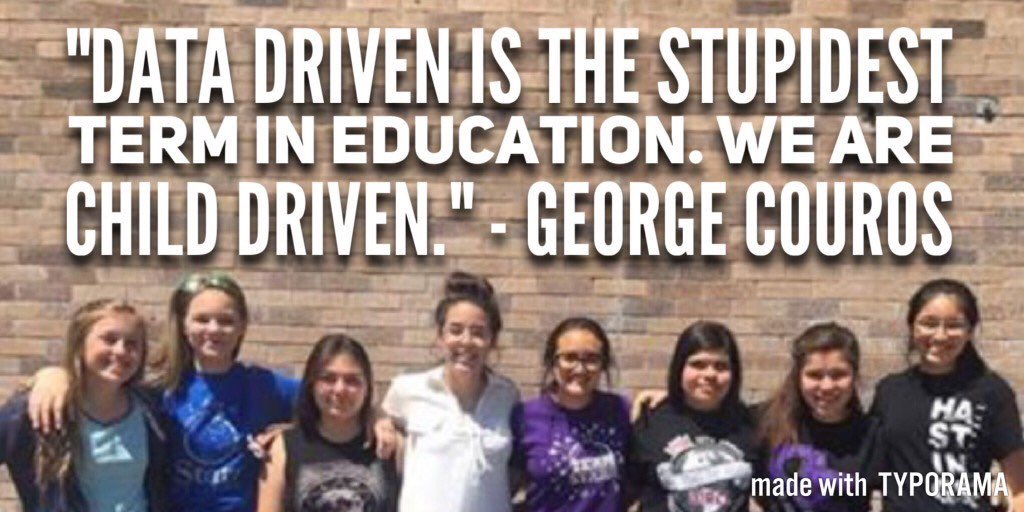
It seems fitting that this quote from George Couros came across my Twitter feed this morning
It's no secret that I hate testing. I've written previously about my views on the damage that our incessant obsession with testing can wreak, and its effects on social studies education. I hate testing. But as I railed on about my issues with tests, I found myself asking if I was practicing what I'm preaching. Can I hate standardized tests, and then be ok with giving test after test in my own croom?
In the end, I felt like I was being hypocritical, and set my mind to exploring an alternative path to assessment. I still believe in assessing student knowledge, and I still think that mastery of content must be a goal. But does a test need to be the go-to option for that assessment? After exploring several approaches offered by my awesome PLN, and after talking extensively with a colleague of mine, I became intrigued with the idea of student choice for assessment. This is by no means a new idea, but I was excited to see how it might work in our croom.
In the end I developed something I call "demonstrated mastery." I like this term because I think it reflects the two purposes behind the effort. Student choice is reflected in the student choosing a method by which to "demonstrate" their "mastery" of the subjects we have covered in a unit. As I began to consider how this would work, I thought about a few key questions:
Do I allow the students to simply come up with their own method, or do I offer them choices that I've developed?
How do I ensure equity in the assessment? In other words, how do I assure that there isn't an "easy" option?
Do I include a test as one of the options?
We just finished our first foray into this new approach, and here is how I set it up. I decided, in the end, to develop the choices myself. I began developing this effort a few weeks before we started through a conversation with the kids, and I could clearly see that they had never done this kind of thing before, thus I thought it might be easier to develop a set of choices and then present them to the kids. I decided to offer three choices- a written option, a creative option, and a test option. In the end I thought about the students in my classes, what they might want, and even thought about myself as a student. Ultimately I decided that there were, undoubtedly, at least some students who didn't mind a test, and felt like it had to be included as an option. The written option was connected to the "essential questions" around which our class is built. Nearly everything we do in class is connected to one of these questions; I tell the students that our goal is to be able to answer that question when we are done with our focus study. It made sense that we incorporate these into an assessment option in the form of a free-response. Finally, I have several students who are artistically-inclined and extremely creative and felt that there needed to be an option that would, perhaps, better serve them. For this round, the creative option was the creation of a newspaper.
Finally, I needed to consider equity in rigor; I didn't want the students to pick an option because it seemed like the "easy" option. Fortunately, these options presented a series of trade-offs; each requires work and preparation, but in different forms, and certainly with different payoffs. The test requires less in the way of production but requires actual studying and the hope that the information sticks when the test sits in front of you. The written option allows the student to explain their answer, but again requires preparation for an "in the moment" assessment. The creative option asks for more in the way of production, but students don't have to stress about producing the knowledge in a test environment. With a group of students who had not worked with this type of setup, the right choice was really hard, and we talked at length about the trade-offs for each option, and several of the students, surprisingly, initially chose the multiple choice option, but changed the following day to one of the other options. The division between the test and the written option was pretty even, with a spattering of students who chose the newspaper.
Following our trial run at this new assessment paradigm, I surveyed the students to gauge their feedback. Overall the feedback has been positive, with my favorite response being, "Not everyone learns and comprehends things the same; some people may not be as good at certain types of tests as others and I believe their perspective should also be valued. You shouldn't feed every zoo animal the same food." Moving forward I plan to use this strategy in the attempt to accommodate each student as much as possible, and I look forward to adding different choices.
December had hit, and I was generally dissatisfied. The end of the semester is always a time for general reflection, and to begin thinking of the new year ahead. And I was dissatisfied. I teach seniors in government, and I have long felt it my mission to help my students emerge from our time together prepared to engage as active citizens. A key element of citizenship that I believe is severely lacking in all generations right now is the ability to engage in a productive conversation with someone, and not have both parties focus on trying to prove the other wrong. Was I doing enough to encourage this kind of productive conversation in our croom?
Over winter break I rewrote nearly my entire government curriculum, with an emphasis on students engaging in reasoned and productive conversation, and thinking with a solution-oriented mind rather than one solely focused on the argument. The areas of most significant change have come in the presence of more cultivated opportunities for discussion and in assessments.
Discussion has always been a presence in our class, but I wanted something more substantial, that not only allowed for the students to have a voice, but also encouraged the students to see the importance of having a substantiated opinion, as well as the importance of valuing multiple perspectives on an issue. To this end, the SAC, or "Structured Academic Controversy", has been a valuable tool. A SAC is generally defined as "a discussion that moves students beyond either/or debates to a more nuanced historical synthesis." A fantastic, full explanation of a SAC is found here, but in essence the teacher should pick a topic that has current or historical pertinence, and then ask students to adopt a point of view that is substantiated with evidence. As a teacher, the best part is the freedom that this format affords.
For our government class, I have used the following format to structure our discussion:
Start with an essential question tied both to what we are covering at the time, but that also connect to current events. The first SAC we worked through, as we began talking about the foundations for the Constitution, asked students to respond to the following statement- “Freedom/Privacy is more important than Order/Security.” Most recently students worked with the following- “What are appropriate regulations on guns? Some, none, all? If some, which ones? Whatever your small group’s answer, be ready to defend it.”
Determine how the students will work. Since my classes are so large, and I want to make sure that every student has a chance to speak up, I generally start with small groups. For the first prompt, I assigned each small group with a POV to research, and to prepare to discuss that view when we came together into a larger group. They, of course, had ample time to discuss their own point of view as well. For our discussion on gun regulation, students worked in small groups again, but this time I tasked the students with achieving a group consensus, which they then presented to the class.
Stress the three keys- Think, Talk, Justify! I want the students to think deeply about these questions, and that includes consideration of perspectives different than their own. I want the students to voice. Our students have a remarkable voice, and they need to know that adults value their thoughts. Finally, I want the students to back up their views with reasonable evidence beyond social media and family.
We discussed the gun regulation prompt the week immediately following the Parkland shooting, and to be honest, I was a little nervous about how it would go. I knew going in that I had students who had strong feelings about guns, but I trusted them to be able to engage in reasonable discussion and consensus building. And, as usual, they knocked it out of the park. There is undeniable effort in structuring the discussion, providing possible sources, facilitating the conversation, etc. on the part of the teacher. But the payoff is so worth it. To see a group of 17 and 18-year-olds reach a consensus on the topic of gun regulation at a time when passions are high, and compromise seems far-fetched was truly inspiring to me.
Our students have a voice, and that voice has value. The real question will be- do we have ears to listen?
I'll try to keep this one short. Many of the posts I've written here have been written in reaction to something that has weighed on me, something I've found troubling. And I've always told myself to wait a few days before I wrote, to get my thoughts straight, to cool down before I post something. Not this time.
I've purposely written this right now, when I'm angry. When I'm not cool. And I offer no apologies for it.
I am sick and tired of watching the news and seeing children run for their lives from a school building. I am a father, and my son is in elementary school. I love him with everything I am. And every child I see running from school has his face. I am a teacher, and I have over a hundred students who I love deeply. And every child I see running from school has their face. I am tired of thinking of parents who have lost their most precious thing. And although I am inspired, I am tired of reading about teachers who have lost their lives shielding their students. I am tired of being overcome with emotion. I am angry.
Parkland was the 18th time since January that I have seen children in this situation. 18. Since January. And 18 times I have seen our "leaders" make speeches and tweet about how sorry they are. And I no doubt that this will the 18th time that nothing will change, no action will be taken. (And yes, I put "leaders" in quotation marks, because leadership is not found in the title, it's found in the action.)
And, since the Parkland tragedy, it is the 18th time this year where I've seen social media filled with excuses for why something is not part of the problem. It's not a gun problem, it's not a people problem, it's the school's fault, it's the parent's fault, heck I even saw the President seemingly blame it on the students for not reporting this student. Here's the deal- I'm not here to tell you that I know who is to blame. All I know is that it is EVERYONE'S problem.
I'm also not here to pretend like I know the perfect answer to these senseless tragedies. All I know is that I stand with those who want everyone to save their sorry's and tears, and focus on the tough conversations that need to come next, and the actions that need to be taken. These conversations need to include everything. We need to be able to say the word "gun", and not automatically assume that every gun is going to be taken from every American. We ought to be able to have real conversations about guns. We need to talk about mental health. We need to talk about what schools can do to better protect students. We need to realize that not every possible answer is the right one, but that we have throw everything on the table and talk about it. And more than that, we have got to act on it. We need to understand that it's not just DC that should be talking about this; these conversations need to be happening in our schools. Every teacher should be angry when they see schoolchildren fleeing for their lives. What has made me, perhaps, the angriest has been to see fellow teachers focus their feelings on something other than the students in their charge. If you are a teacher, and your first and foremost concern is not the safety of your students, I don't get you. If you are a teacher, and you're not angry about this, I don't get you.
I had lesson plans yesterday, and for the most part I followed them. But before we worried about that, I told my students that I love them. I don't do that enough. My thoughts are consumed with the thought of "What is that was my son?", "What if those were my students?", "What if I lost even just one?"
In our croom, my love for my students is real.
Their safety is my priority.
My anger is real.
And my motivation for action is real as well.
Please, call your legislators. Annoy them with pleas to make the conversations and action a reality and a priority! If you live near me, here is the info for Congresswoman Susan Brooks- 1030 Longworth House Office Building
Washington, DC 20515
Phone: 202-225-2276
Fax: 202-225-0016
Amongst the biggest concerns I have for the future of this country and my students is the current polarization we are experiencing when it comes to politics. We have lost the art of the conversation, we have become the culture of "no politics at Thanksgiving." I often tell my students the story of the Constitutional Convention, that in the hot summer of 1787, a group of men met to draft a new government for the country. These men came from different backgrounds, and brought with them different agendas and values. They argued, they debated...and they compromised. They emerged with an imperfect document for sure, but one that created a government that was, without question, better than the one it would replace. And they did it because they were able to have a conversation, a dialogue, and leave it without anger, but with compromise. One could argue that the "conversation" is truly what the country is built upon. 231 years later, we are stuck with the rule of "no politics at Thanksgiving". It brings to mind the great words of Dubois- “What a world this will be when human possibilities are freed, when we discover each other, when the stranger is no longer the potential criminal and the certain inferior!”
What I know is that, if there is to be any hope of change, it must begin with our students, and that this change can only be achieved if they are encouraged, and given opportunity, in the skill of deliberation. The challenge of deliberation is talking with someone who may think differently than you, and instead of working to find holes in their thought process, being focused on listening to what they have to say, and appreciating what might be a different perspective. When we focus on listening rather than attacking, the opportunity for growth is much more likely. Is deliberation an option for all conversations? No- there are still some universal truths in which there is no conversation, e.g. racism. But there is ALMOST always a conversation to be had.
The key to creating a deliberative space is starting on day one, and setting expectations for discussion and, if possible, getting the kids involved in the deliberative process early. One of my favorite "first day" activities is one that I borrowed from a lesson from the Choices Program that I call "Opening Day Values". It is worth noting that this is an activity that I typically use with my senior government class, but it can certainly be adapted for younger audiences. These classes tend to be fairly large, which can impact the way in which the activity is carried out. The way in which the "values" are put forward to the students can be varied; I will simply explain how I use it.
I begin by having stacks of blank white paper, cut into squares, in the middle of our workspace. As we begin class I ask each student to pull 10 slips from the pile. I then take time to explain that, in any society and government, decision-making is a theme to be discussed, and that decision-making is often guided by one's values. In this activity the students will be presented with 9 key values that could be found in American government, and will be asked to rank those values. I project the values on the screen 1 by 1, and have the kids write the words on their slips as they go. As students get new words, they place them in rank in front of them, often reordering them as they go. The 9 values I project are: freedom, equality, self-reliance, justice, cooperation, security, competition, stability, and democracy. There should be one blank slip for later.
Once the students have all of their value words, time should be given for final ranking. I like to throw some questions at them as they rank their values- "If you had to justify what you ranked first/last, how would you do so?", "How do you define this value? How might someone else define it?", and my favorite "Looking at what you've ranked first, are there any of the other values that one needs before that value can be achieved, and if so, does that change your ranking?" It's pretty common to see lots of shuffling!
A key part of this activity is the debrief. I often, if time allows, have the students start by discussing their rankings in small groups. But I also put the value statements on the board, and ask the students to mark their 1, 2, and 9 values, either by writing the numbers with marker or by using post-it notes.
Once done, we discuss as a class, and students are often surprised to see how the values lay out. We talk about why some values are ranked high or low, and I open up the room for students to discuss why they ranked values where they did. The best conversations come from those values that have both 1's and 9's in the same spot!
To wrap up the activity I make sure to ask the students to do two things. First, using the last blank slip, I ask the students to consider other values that might not have been listed, and if they would like, write this new value and add it to their ranking. I also ask the students to keep their list somewhere it won't be lost, and we do the same activity at the end of the year, after we've studied our government and discussed current events and issues.
Deliberation is a skill, and one that is desperately needed, and needs the opportunity and environment in which to be honed. Often times the biggest issue in building a deliberative classroom is breaking through on the first discussion and making students comfortable in lending their voice. Structuring an activity that asks the students to think and deliberate at a personal level is a great way to found such an environment.
My favorite part of the #oneword movement is the reflection. #OneWord is designed for an individual to conduct a series of introspective exercises in the hope that, in the end, "one word" emerges that sums up one's hopes, goals, focus, direction for the coming year. My reflection for this year began several weeks ago, and I'm excited to finally come to my word.
As I began to reflect on my focus for the coming year, I considered both my personal life and my professional life, specifically my children and my students. And I was surprised...actually maybe not so surprised...to see how frustrated I really am. And how much my frustration bled between my two foci. My frustrations as an educator are combined with my frustration as a parent. My frustration for what I hold as my hopes for my sons are in many ways mirrored in my frustration for the future of my students. And, as I came to find, my direction, my focus, my "one word" pointedly summed up what I need to do.
My #OneWord for 2018 is "In".
Before I explain why this word works for me, let me explain the root of this frustration. As an American, I'm frustrated with the current direction I see our country heading. After nearly a decade of what I felt was real progress I feel like we are regressing. I'm frustrated with the dearth of leadership I see in this country. As an educator, I am frustrated with the current educational paradigm, one in which public education has become far more about tests than kids. I feel like I've noticed this reality more this year than ever before. The volume of time we spend in our crooms preparing for, and then administering, tests is alarming. And one of the most frustrating by-products of this testing mania is the impact it is having on the teaching of social studies. In previous posts on this blog I have detailed my feelings on the importance of a strong social studies curriculum, and what our students miss without it. At a time when we need to study history more than ever before, both for the lessons it holds but also for the examples it puts forward, we are cutting it back. At a time when we need to be encouraging environments where critical thinking and civil discourse are promoted, we are finding social studies crooms a convenient thing to cut. And, in the end, this frustration comes back to my most important role, as a parent, and in that role I am worried about how the consequences of decisions being made now could impact my sons.
While I'm frustrated about many things, I've never been a wallower. I prefer solutions, and my reflection led to the realization of what I have to do in the face of these frustrations. The answer is in action. Action in helping to develop stronger leaders. Action in fighting for the social studies, and making sure that my croom is one in which the skills of critical thinking and dialogue are being encouraged. Action in no longer being silent when I see something I know is wrong. I once heard a great teacher say that "silence is dangerous", and I know that's true. In short, the solution to these frustrations lies not in sitting on the sidelines, but from being "in" the game.
Over the course of this year, my hope, focus, direction is that, if you're looking for me, I will be the one in the croom where students are engaged in discussion, dialogue that is backed up by substance, and where these same students are being challenged to look at multiple points of view. You will find me here, in this blog, speaking out. You will find me active in the social studies community, fighting for the present and future of the field. You will find me on Twitter, learning from the countless educators that make up my PLN. And, most importantly, you will find me at home with my two boys, helping them to understand the importance of love, respect, and leadership.
Where you won't find me is on the sidelines. For 2018 and beyond, I am IN!
A "reckoning." I'll apologize to my 12th grade English teacher for starting with a definition, but "reckoning" is defined as "a settling of accounts", a moment where someone must take responsibility for realities. I've heard this term used quite a bit lately to describe this moment in which, seemingly almost daily, allegations of sexual harassment or abuse are being leveled, and major names are falling left and right. In truth, I think this term fits the time. Or at least I hope it does. A reckoning implies reflection, and as males, fathers, uncles, teachers, men need to reflect on attitudes, and how we think of/speak about/treat women.
I remember vividly how I felt last year when I heard the now infamous "Access Hollywood" tape, in which a man bragged about sexually assaulting a woman. I remember...disgust. I still feel disgust. And as angry as that video made me, I remember being even more frustrated at the excuses made to somehow dismiss this kind of behavior. I remember thinking- "How does someone get away with saying something like that?" And I remember, as I proceeded further in judgment, the personal reflection it sparked in me. What was I contributing to this environment, this reality? A reckoning.
In a country facing countless issues, this has troubled me the most. Perhaps because I am a husband, a father to two young men, a teacher to young men and women I love like my own. Maybe because I am a man. Maybe because of the difficult questions this reckoning poses- Can we project ourselves as an image of moral superiority when we are still trying to figure out right from wrong? What does it truly mean to be a "man"? What are my responsibilities as a father? What are my responsibilities as a teacher?
Perhaps unsurprising in a country that took over 140 years after its founding to figure out women could handle voting, we seem to have become quite good at excusing the mistreatment of women. This mentality has to stop. When Trump's "Access Hollywood" tape came out, I heard from more than one person "boys will be boys"; I heard this man dismiss it as "locker room talk". This mentality has to stop.
Before I proceed further, please understand this reckoning has not spared me. Over the past several months I have been forced to re-evaluate my actions, my sense of humor, my culpability, past and present. In my youth, did I engage in what might be termed as "locker room" banter- yes (although I can safely say nothing to the level of our President). I know, and can say confidently, that this is the extent of my part, but we cannot accept this as ok. I have been forced to think about what I say, do, and think. And while I'm ashamed of certain things I have, in the past, found humorous, this reckoning had to apply to myself. I think about this as I consider solutions, and my responsibility.
The nation-wide reckoning must make its way into every mind, home, and workplace, including our schools. I am a teacher. I am a male teacher. As a teacher I am not simply tasked with teaching my students about the Civil War. I am also guiding my students in life preparation. And our students are emerging into a country in which this reckoning is taking place, where serious questions are, and should be, asked about how a woman should be treated. Examples that might normally serve as role models for our young men are no longer role models. Our students cannot look at their leaders and find inspiration. Our students will have trouble finding that in our celebrities and athletes. Let them find it in us. We are not in the business of sculpting their beliefs on things like politics. But we have to understand that there a few universal truths out there. Racism is wrong. Sexism is wrong. Women deserve to be treated with respect. Our female colleagues must feel safe and protected in their work environment. Our female students must feel safe and protected in their school. Our male students must see examples of good men in their school leaders, and this must extend both to what we project publically and how we behave privately. We cannot demand respect in front of our classrooms and school, and then not extend it when we think we are talking with friends. The truth is that an entire generation of men must relearn the definition of what it means to be a "man", and that has to start with us. Why should we be appalled with a man engaging in what he called "locker-room talk" when we are not going to re-evaluate our actions as well?
It is the responsibility of every school leader to evaluate the culture and environment of their school. Does a woman have to fear working in a school in which they know that comments or jokes are being made that sexually objectify them? Do the women in the building feel safe and protected, and not just in public but also behind closed doors? School leaders must be willing to live what the expect in students.
It is the responsibility of every classroom teacher to do the same. Will our female students enter your classroom knowing that you are there to support them, and will take the actions of other students seriously? Do our students understand that comments and jokes in poor taste will be dealt with strongly and seriously? Will our students know that you are not simply acting these values, but living them as well? Will our students be able to look at you as a positive example?
"It's just locker room talk" cannot cut it anymore. "Boys will be boys" cannot cut it anymore. Women deserve to be treated with respect. They deserve better than being the punch line of a sex joke. There cannot be excuses for objectified behavior. There cannot be justification. There must be consequences for this behavior. I won't say "our country is better than this", because we are not. But we "can be better than this", but this will only come with the kind of critical reflection that is the hardest to make, but always promotes the deepest growth. This requires a reckoning.
Over the past few weeks, I've been given cause to really think about the state of social studies education, and it's overall place in nationwide curriculum. I've taught now for 13 years, and I remember starting out and struggling to find a teaching job. My resume was strong, but I just couldn't find a job. I also remember being told that this struggle might be the best thing to happen to me in the long run, that it might convince me to move on from this field and find something where my work might be valued. But I stuck it out, and secured a job in the same school I find myself now. And I am glad I did. I wouldn't trade the experiences I've had teaching my students for anything. But as the years have gone on, I've come to see that there might be a little truth in the advice I received all those years ago. Although I know that teaching history is vitally important, and I have been blessed by amazing kids who have always made me feel appreciated, the overall view of the importance of history education has diminished to an alarming level. At a time when history education has never been needed more, it has never mattered less. And this reality should scare everyone.
I recently had the chance to hear Eric Foner, the noted historian, speak about teaching. He explained that he had taught for over 50 years, and in that time had seen many changes in the field, most notably in the foci of history, from emphasis on political history to social history to a new age of history in which more focus is given to minorities. But, Foner argued, what had always stayed true, through 50 years, was the centrality of history in education. All of that has changed. In a recent #sunchat discussion on Twitter, teachers shared our current frustrations and blessings. I expressed my frustration over the lack of value shown to social studies, and heard back from several teachers who had the same frustration. One teacher explained how her corporation listed social studies as a "special"; others shared how the requirements for students varied, some as few as two years of classes. How has this happened? How has social studies become the convenient thing to cut? How has history education become so devalued? As it turns out, it is a complex question with a fairly simple answer.
The harsh reality of education is that, not only has social studies education become devalued, our students have as well. There- I said it. Education has become a numbers game. Our schools are testing centers and our students are simply statistics, bubbles on a scantron. The moment we allowed standardized tests to become the epicenter of education is the moment we devalued our students. And before I'm written off as just another teacher complaining about tests, think about it, step into a school and find out just how much instructional time is taken away by testing. These are days teachers don't get back, and sacrifices have to be made. One of those sacrifices- social studies education. Social Studies is not a widely tested subject, therefore, in the current paradigm of education, it is of less value, and therefore open to cuts. The focus is on language arts, math, and science. Now don't get me wrong- we need people skilled in all three areas, and ready to fill those jobs. But what are we losing by devaluing history education?
Social studies classrooms are the places where students not only learn about the events of the past, but analyze them, examine them with a critical eye, and discuss them. These classrooms are where we study the successes and failures of the past, and learn from both. This is where students have the chance to grow in their ability to engage in a civil discourse, and learn to reason with an informed mind. I can't guarantee that every student in a social studies classroom is going to leave our walls and pursue a career in history. But I can guarantee that they will leave a well-taught and organized social studies classroom with skills crucial to being a citizen and a person. And as the great educator, Lester Laminack said, "We're not here to raise a score. We're here to raise a human."
So, what do we do? First, encourage professional organizations within our states to increase their advocacy. Legislators may not fully understand the effects of testing on subjects like social studies, but they need to know. Second, let your own voice be heard. Tune into the work of groups like NCSS and Gilder-Lehrman, and seize upon their passion and resources to "Make Social Studies Relevant Again." But more than anything, continue to be a passionate advocate for social studies. Continue to put the kids first, and allow your passion for them and the content shine! Be a positive voice, and continue to fight the good fight. Our students and our country need you!
Recently we culminated that yearly tradition that is parent/teacher conferences. I've always loved these conferences, as our conversations with parents are a great time to share the praise that can be found in every student, and the opportunities we each have to grow. This year, however, I heard, more than ever before, from multiple parents about the conversations that they were having at home, conversations that originated in our croom and were now making their way to dinner tables, car rides, and evening chill time. To me this is one of the truest signs of learning and is part of the solution to a national problem- our increasing inability to engage in productive conversations about our history and the issues facing the nation right now. And it has me thinking about how to increase the frequency of these conversations.
The conversational divide in our country is one that even the blindest among us can see. Of the many problems plaguing our country, this one stands out as both a root cause and a solution. It's ironic to a degree, with so many talking about "what this country was founded on", that one of the truest, most base founding principles is the one perhaps most lacking right now. This country was, in so many ways, founded on the conversation. Few of our Founders and Framers agreed on everything, if anything, and yet this country came to be. Imperfect for sure, but one capable of growth, an "experiment" that most would argue has gone demonstrably well. Why- because our Founders talked, certainly with those who agreed with them, but more importantly, with those who didn't. That is how compromise is made. That is how understanding is reached. That is how growth happens. Today we have evolved into a country in which the popular maxim is "Don't talk about politics at Thanksgiving" or something of the like. That maxim has to go; we need, so desperately, to talk more, listen more, grow more. So it warms my heart to hear parents talk about how the discussions we have in class are coming home and continuing.
This brings up, of course, the need for us to model effective discourse. While I do have a few "absolute truths" which are not debatable in our croom (I will not tolerate comments when it comes to things like racism, sexism, etc.), most topics are worthy of a good back and forth. But if all we allow is free-for-all debate, we miss the chance to stress the importance of listening. Debate is not a taboo word, and can be effective when listening is stressed. I often tell my students that at least half of a great conversation is listening. I also stress to my students the need to engage in informed discourse. Imagine a country in which the citizens were willing and able to sit down with anyone, and speak on the issues of a day, a discussion rooted in actual knowledge, and one in which all involved left the conversation with a little more understanding. Imagine if our crooms were a place where these kinds of discussion were not only allowed, but encouraged, and these conversations carried their way home. Imagine if we were a nation of citizens content in the conversation, and not focused on being right. If that is an ideal, call me an idealist.
Even though I know that not every student will leave their time with me and be this kind of citizen, it doesn't stop me from trying. To that end, a few of our efforts...
Don't shy away from the tough topics, but change the way they are discussed. I teach government, and when we discuss the Constitution, the conversation inevitably steers towards the Courts, and how civil liberties and rights have been interpreted over time. This leads us to discussions of discrimination, same-sex marriage, abortion, etc., all issues which would easily lead to blow-ups. But if we want our students to emerge as functional citizens, we can't skip over the topic just because we are afraid of the conversation. Our crooms have to be the laboratories where the American experiment grows, where informed dialogue is encouraged.
Set rules- establish the "lines" for class discussion across which students are not allowed to cross. A few of our rules- your voice has value, be prepared to support your point with serious evidence (and no, Grandpa doesn't count), speak with respect and listen with more, do not speak until called on (don't try to speak over others).
As teachers and discussion facilitators, we have to be prepared to speak from the other side, even if you disagree with it personally. I know many teachers who share their personal views constantly; there can be some value to that. But, in general, I keep my thoughts on most issues to myself so that I can argue another side without the students believing me to be biased. Plus it's fun to see the students try to guess where I stand.
Challenge students to speak from a point of view contrary to their own. I also teach US History, and often put students in groups which will likely push them to see another side, eg. Federalist v. Anti-Federalist, or in government I might have the student present on a Constitutional point different than their own. Having to argue from the other side of the argument can be a great way to encourage students to look at multiple perspectives.
In the end we have to remember that we are not just teaching a body in a desk; we are teaching the next generation of leaders and citizens. If we don't encourage them to be better than us, to be willing and able to listen, to work with someone who thinks differently, to realize that our world is far from homogenous, then we fail them. If we don't foster opportunities for these young people to grow, we fail them. It's time that we become part of the solution.
In a recent Twitter string based in the weekly #sunchat discussion, one of the many great educators, @thnorfar, mentioned that "something about this profession [teaching] makes people fear weakness." This initiated a long string of discussion, and truly got me thinking- do educators fear expressing weakness? If so, why? How important is this to the larger goal of personal and professional growth? If we can admit weakness, then what? In the post below I will try to tackle each question, and flesh out my thoughts.
Do educators fear expressing weakness? If so, why?
The answer to the first question is, I think, a resounding YES! For so long, educators have been the classroom "expert", the "sage on stage",...and the first person to be blamed for something wrong in education. There is a great deal of pressure on teachers to be experts in all matters education. Some of that pressure is good; we should have a deep knowledge of our content, and we should take the time (and have been challenged) to think deeply about classroom practice. But how many teachers are afraid to say, "I don't know", when asked a question.
The truth is that education has become, in many ways, a game in which all things are measured by "winners" and "losers". When it comes to the classroom, it comes down to grades- does your class average match out, do you have enough points possible, do you have enough students getting A's? When it comes to the school, it comes down to test scores- are they high enough, how do they measure against every student in the state and country? In short, education has become more focused on statistics than people, more focused on numbers than growth, more focused on students as commodities rather than as the individuals they truly are. When educators function in this kind of environment and feel the pressure of being blamed if points possible don't meet quality, or if test scores aren't high enough, it sends a clear message- You had better get it all right, or else. It's no surprise that a teacher might be afraid to admit weakness with that reality bearing down upon them.
How important is admitting weakness to the larger goal of personal and professional growth?
Fact- Teachers are human beings. (insert gasp from students) We are human, we are flawed, we have weaknesses. Being able to admit that is absolutely crucial to maintaining oneself in education. I was once scared to say "I don't know" in a classroom, afraid that I might lose the respect of the students in my charge if I couldn't answer that question they asked, afraid of how I might "look" to other professionals in the building and beyond. But the moment I embraced my weaknesses was the moment that I began to experience real growth. Knowing one's weaknesses shows a teacher how much they still have left to learn, and motivates growth.
If we can admit weakness, then what?
It is unfortunate that most teachers work in an environment driven by test scores. It is an environment which is ultimately successful in creating little more than fear, and hinders the important elements of growth in the classroom. While difficult, admitting weakness is crucial for us to grow. Even more importantly, teachers must work to not only admit weakness, but seek out ways to improve. It is one thing to admit weakness; it is quite another to take the steps necessary to better oneself.
The field of education has not only accepted a culture of test scores, but it has also grown comfortable in dated or just flat-out flawed teaching practices. Growth as a professional is as important as anything we do as educators. The on-going challenge before educators, and administrators, is to admit weakness, but never accept it. Only when teachers make the decision to stop growing have they truly failed. Growth is success, and one of the few legitimate constants in this field! But growth means failures along the way. Every journey has detours. But, here is the real question- how far will you drive the wrong way?
Yesterday I was asked by a number of students how I felt about the kneeling controversy, largely because I had made the decision over the weekend prior to change up our schedule for US History to allow us greater time to spend with the Constitution, and I had shared with them that if there was one thing that the debate on social media had shown me over the weekend, it was that more Americans needed to spend time with the document before they claimed themselves to be experts. When students asked their question, I gave a wishy-washy answer with which I wasn't comfortable. And so, I've decided to compose my thoughts in my blog.
I would like to preface this post with a few notes. First- as always, the views expressed in this post (and all posts) are mine alone, and do not necessarily represent my employer. Second- I have long maintained a personal mission to not interject my personal reactions to political issues because of my desire to help students see multiple perspectives on issues. Third- I have always stood for the flag and national anthem, and am proud to do so.
When this post began to form in my head, I thought back to something which President Obama said during a town hall. He was asked by the moderator, Jake Tapper, about his reaction to the initial kneeling of Colin Kaepernick, and he responded by talking about what the flag means to him, and how he feels that the flag and anthem can be a unifying force for all Americans. But then he also said this,
"I also always try to remind folks that part of what makes this country special is that we respect people's rights to have a different opinion...The test of our fidelity to our Constitution, to freedom of speech, to our Bill of Rights, is not when it's easy, but when it's hard. We fight sometimes so that people can do things that we disagree with ... As long as they're doing it within the law, then we can voice our opinion objecting to it but it's also their right."
It was the second line that really came back to me- "The test of our fidelity to our Constitution, to freedom of speech, to our Bill of Rights, is not when it's easy, but when it's hard." Listen- I don't believe in many universal truths, but those that I do, and which will always be a part of any classroom I work in, are that 1. Sexism, racism, and hatred will have no place in our classroom.2. Our students have rights, and when given the environment, can and should express those rights. Our students should know and feel that they have a voice, and that their voice has value.3. If students (or any American) wants to express their right to a voice, it should be informed. Ignorant speech is just as dangerous, and often times more so, than keeping quiet when your voice should be heard.If one thing has become very clear over the past few years, it is just how reactionary a people we can be. Too often we instantly react when we see something that makes us uncomfortable, when the reality is that there is almost always a moment to stop and think, almost always a need to have a conversation, almost always another perspective just as valuable as your own, and almost always a need to empathize.
Regarding this particular controversy, here are my thoughts:
I stand for the flag, but at the end of the day what I am really standing for is the ideal the flag represents. If we look at the flag in a literal sense, it is really just fabric. But, as a symbol, it stands for freedom, our Constitution, all that we have fought for over the course of 240 years. I stand for that because that is how I express my feelings about this history, I stand for that because I believe in what it represents- the rights we all possess as Americans. A hallmark of those rights is the right we have to express ourselves freely, provided we remain within the law. The First Amendment speaks of freedom of speech, and does not qualify that with provisions for anyone's comfort. Protest is central to our nation's history, so much so that it could be argued that protest is a fundamental American principle. And so, for those who want to express frustration about kneeling protests, you have the right to do so, and I would be the first to defend that right. If seeing this kind of protest makes you uncomfortable, I can understand that as well. But you do not have any greater right to express yourself than those who choose to kneel. We all have equal right to protest, and at a time when we have "protestors" marching through streets, waving Nazi flags, spewing hate speech, and driving their vehicles into groups of other protestors, a peaceful protest, even one that might cause us some discomfort, is far from our biggest problem.
This may seem like an "easy" issue for many to give voice, and if you have or wish to, that is your prerogative. But there are rarely issues that are easy; with the exception of a few absolute truths listed above, there is almost always a conversation to be had, almost always multiple perspectives. In this case, if we examine the root of the initial protests (taking issue with the treatment of blacks and other minorities in the United States), my reality is that I, like most, have no idea what it is to be a black person. I certainly have no idea what it is to be a black pro athlete. I would love to have their money, but I would never trade for their history. Most of us cannot fathom studying our people's history, and seeing so much of it dominated by slavery. Most of us cannot fathom watching the news and being concerned with the realities of race relations. How can we take issue with someone expressing their thoughts, exercising rights possessed by them, just because they are highly paid athletes? Their money doesn't take away their rights as a citizen, and for many of the black men and women, they carry the responsibility of being highly visible and looked up to, and as such it should come as no surprise that they might use their platform to initiate change, or at the least, a conversation.
So, my thoughts- I stand for the flag and will continue to do so. I hope that these players will think about their protests, and consider why some might take issue with it. I hope that those who are so quick to condemn them would remember that they are simply exercising a right, knowing full well that there could be consequences for that right. I would hope that we all might remember that freedom of expression and speech either means something, or it means nothing at all. I will continue to hope that, one day, we will realize that we are a nation constructed out of compromise, and a desire to live free. That we are stronger because of our diversity, that the great glue that holds our nation and people together is the great conversation we've lost, and must get back. And I would hope that the same verocity with which some have approached this issue would be applied to helping others in need, like Americans affected by natural disaster, including the thousands of Puerto Rican Americans without power.
Starting a new school year means a new year with one of my favorite student groups- the Frankton History Club. Nine years ago, students in one of my history classes asked me, "You know Mr. Cline, we have a Spanish Club, a French Club, a Science Club...why don't we have a History Club?" That question was the spark that led to the creation of what has become one of the most active and popular student organizations in our school, and has, without a doubt, helped to motivate increased student interest in the classes we offer within our department. Since I've been asked by several colleagues to share what we are and what we do, here is a quick rundown.
I've always approached this organization with two thoughts in mind. One- I want this to be student-driven as much as possible. Two- I don't want this to become the "field trip club". To the first point, we generally begin each year with a call-out meeting, and immediately I start talking to kids who might have interest in joining our leadership team. In the past we have used executive officers, but this limited the minds contributing to planning, and so we have blossomed to a 10 student team. These students are central to the planning and implementation of the the club's activities. I obviously want to plan activities which will interest our students, and I want the students to buy-in to the work we are doing. Having a student-led leadership team does just that.
HC Students with Guest Speaker
From there we work towards a goal of planning one activity per month. We strive to vary the activities we plan to include field experiences, but also guest speakers, movie nights, community service, etc. This year we are excited to already have several experiences already in place, including:
A trip to the Mississinewa 1812 Reenactment- Indiana doesn't have many historical battles around which to build a living history experience, but one that we can count is the Battle of the Mississinewa, which took place near to our school during the War of 1812. This reenactment, while built around that battle, focuses more on the country at the time, and gives students a great experience in speaking with historians. Plus the food is amazing!
HC at 1812
Participation in the "Follow the North Star" program at Conner Prairie. Central Indiana is truly blessed to have this living history museum, built on the grounds of the William Conner estate. William Conner was an Indiana trader, and his home and land form the basis for an experiential landscape set in 1836 Indiana. This program revolves around Indiana's role in the Underground Railroad, and places students into the role of an escaped slave. The experience is intense and thought-provoking!
Conner Prairie
One of the best decisions our club has made was to become affiliated with the National History Club. Through this group, our club is able to sponsor a Senior Award (which features the winner recieving a copy of the HC Book of the Year, which is autographed by the author), and the National History Honors Society. This group has also started publishing newsletters, monthly emails with resources, and has a Facebook group in which advisors can share ideas.
Honor Society Inductees
The time I have spent with students in this organization has been amongst the best I've spent in 12 years of teaching. Teachers should always endeavor to build authentic learning experiences into the traditional classroom, but with increasing class sizes, and varied student interest, this isn't always easy. Our history club has proven to be an outlet for specific study, and has allowed students the chance to study elements of history which interest them on a personal level. It has provided opportunities for our students to make history real, and that has sparked interest in continuing their research. If you are a history teacher, consider this opportunity to take what you are teaching outside of the classroom!
Over the past week I've had the tremendously good fortune to study the life of Alexander Hamilton, a week which was prefaced with some great reading from experts like Richard Brookhiser and Ron Chernow, and which was peppered with lots of the Hamilton mixtape. As a history teacher I've obviously been well aware of Hamilton and his impact for some time, and have made every effort to incorporate him into our curriculum, but have met with a lot of blank faces. Prior to 2009 far too many students had no idea who was on the $10 bill! All of that, of course, changed when Broadway star Lin Manuel Miranda did this at the White House:
Since then, and certainly after the release of Miranda's hit play, it's been much easier to pique student interest in the man, and I've had a lot of fun the past few years using the play as a way to bring deeper conversation on the Founder into class. But the nature of that conversation will likely change after this week, as, after the lectures, conversations, and readings, I've come to appreciate Hamilton in a new way, as someone who, even though he wasn't born in the country, may, in many ways, represent the idea of "American potential" more than anyone else of the era, perhaps the first to fully appreciate the idea of the "American dream."
Hamilton's background is famous- born on an island in the Caribbean to a mother who had just spent several months in prison, placed there by her first husband for "whoring". In reality she had simply fallen for another man, and having not lived with her husband for a long time, she had married this new man- James Hamilton. The matter finally resolved, the Hamiltons moved to the island of Nevis, where Hamilton, his older brother, and his mother were deserted by his father. His mother, Rachel, was determined, and started her own business, with her son Alexander as clerk. Just as things had begun to look up, both Alexander and his mother contracted a fever, from which Alexander would survive, but his mother would die. At 11 Alexander Hamilton was a penniless orphan, and, in the eyes of many, a bastard. Fortunately Hamilton was taken on as a clerk for two merchants- David Beekman and Nicholas Cruger- who, after being impressed with his work, sponsored him to go to the colonies so that he could study medicine, after which he would return to the islands as a doctor.
Alexander Hamilton arrives in New York City with only faith in himself, that he offered something that could make a significant place in this country. Hamilton is, in truth, like so many immigrants who have come to these shores, even still today, escaping a situation which had become untenable, searching for something better, believing that America offered just that. Hamilton began studying law at King's College (now Columbia), organized his own artillery unit when the Revolution began, impressed General George Washington enough to be placed on the General's staff as an aide-to-camp, led a successful assault at Yorktown, married the daughter of a wealthy and influential member of New York society, and became a successful lawyer. In short, Alex did good. It is, of course, his work with the Constitution that stands out with Hamilton. Active early, along with James Madison, in the work to replace the deeply flawed Articles of Confederation, Hamilton was key in the call for a convention in Philadelphia, and even more central in convincing his state of New York, crucial to the process, to ratify the new document. Under the new government, which yielded the incomparable George Washington as first president, Hamilton was named the first head of the Treasury, responsible for coming up with a plan to rescue the country from tremendous debt. To describe his rise as meteroic is putting things mildly. To describe Hamilton as the epitome of the "American Dream" fulfilled would be right on.
If Hamilton's rise has become well-known, his death has always made him famous. For all of his gifts, Hamilton's flaws stand out as much. Hamilton was brash (again putting it mildly), with an insatiable belief in his rightness, and was unafraid to let people know they were wrong. These qualities did not endear Hamilton to many, including Thomas Jefferson. It is in this relationship, however, where Hamilton demonstrates his most ardent belief in the "American Dream." As Secretary of the Treasury, Hamilton devised a new financial plan intended to not only rescue the nation from crushing debt, but also to set it on a course for the future which would help ensure advancement. The plan called for an increased focus on manufacturing and industry, which flew in the face of Jefferson's hope for a country of small farms. Jefferson's hope is hardly surprising, being a Virginia planter who had grown up in an agrarian society- it was all he knew. In defending his belief in the need for increased manufacturing, Hamilton offers perhaps his greatest testament to an "American Dream"-
"As to the furnishing greater scope for the diversity of talents and dispositions, which discriminate men from each other. This is a much more powerful mean of augmenting the fund of national Industry than may at first sight appear. It is a just observation, that minds of the strongest and most active powers for their proper objects fall below mediocrity and labour without effect, if confined to uncongenial pursuits. And it is thence to be inferred, that the results of human exertion may be immensely increased by diversifying its objects. When all the different kinds of industry obtain in a community, each individual can find his proper element, and can call into activity the whole vigour of his nature. And the community is benefitted by the services of its respective members, in the manner, in which each can serve it with most effect."
In this passage from his "Report on the Subject of Manufactures" (1791), Hamilton uses his own story to serve as evidence of the need for this change of focus- "...minds of the strongest and most active powers for their proper objects fall below mediocrity and labour without effect, if confined to uncongenial pursuits." In effect, Hamilton argues that, had he stayed on Nevis, had never come to America, his talents would have been wasted. In other words, if the country remains strictly agrarian, too many of the great minds of this country will be wasted. Instead Hamilton argues for a national focus on manufacturing and industry as a means of bringing choice to Americans- if you don't want to farm, then here are the plethora of other options. Later on in the same report Hamilton argues that "...there is, in the genius of the people of this country...it would operate as a forcible reason for giving opportunities to the exercise of the species of talent...". In short, Hamilton is arguing for a system, for a country, which offers choice of opportunity, that these shores offer far too much talent to remain steadfast in the way things have always been done; in effect, Hamilton is arguing to make things easier for future Hamiltons.
In the end, Hamilton's vision has proven to win out. This country has become the cradle of diversity that Hamilton envisioned, at least in diversity of choice. In that lies the foundation for the "American Dream", that anyone could come to this country and find a niche, an avenue in which to apply their talent towards a better life. Hamilton certainly wasn't the first to move to this land with the dream of a better life, but it could be argued that he was among the first to see the true potential of how big those dreams could be.
As I write this, I'm sitting in an Union Square Starbucks, preparing, both mentally and physically (because coffee is the key to both) for day one of the Gilder Lehrman seminar on Alexander Hamilton and Founding Era.
It's a far cry from the Indiana cornfield in which I live, and the neighboring Indiana cornfield in which I teach. But I sit here as both a deeply passionate and tremendously blessed teacher of social studies. I am blessed in the sense that this is the latest in a series of incredible professional opportunities I've had the chance to experience, one which will, without a doubt improve my knowledge and teaching of this important era in American history. But it's my passion that has led me here, a passion founded in the purpose of my field- serving our students. And as a social studies teacher, that purpose must include taking the time to, and seizing the opportunity, to visit and experience what we teach, and if possible, cultivating opportunities for our students to do the same.
By now, if you are a history teacher, I hope that you have come to realize that a textbook study of history offers little other than a base level of knowledge, one that students are destined to forget almost immediately. History studied right is experiential, and that experience includes exposure to the images, words, music, etc. of a time period. And it is defined by the realization of every opportunity to experience the actual location of something being studied. As teachers we need to seek out every chance to offer ourselves the chance to walk in the footsteps of what we are teaching; I can guarantee it will change the way you teach. But we also have to seek out those opportunities to offer the same kind of experience to our students.
1- The Impact of Experiential Professional Development on Teachers
Professional development is one of those terms which I am convinced is defined by the teacher. Can't anything which inspires growth "pd"? These can include more structured experiences, and for those who are social studies teachers (but also teachers of other subjects as well), here are a few of my favorite structured development groups:
Gilder Lehrman Institute of American History- apart from being a first-stop destination for primary documents and other classroom resources, GLI offers a series of summer seminars throughout the country. Each seminar focuses on an element of American history, with a few of this year's offerings running the gamut of the Civil Rights Movement in Memphis, The Second Great Awakening at Princeton, and the one which I am attending right now, Hamilton and Founding Era in NYC. Each of these seminars is, essentially, free, with room, board, and food free, and travel expenses reimbursed. Each seminar is led by an expert in the field, including great minds like Denver Brunsman, John Demos, Eric Foner, and Richard Brookhiser. Teachers are on location for a week, which is filled with lecture/discussion, trips to historical locations relevant to the topic, and time spent on pedagogy and lesson development.
Ashbrook Center at Ashland University- the group associated with the "TeachingAmericanHistory" and "50 American Documents" series, Ashbrooke offers weekend seminars at historical sites around the country, which are, again, free. These are led by faculty of the university, and are based in primary document study and professional discourse. I recently visited Montpelier for a discussion on the Constitution, and if you can't be inspired to discuss Madison's influence whilst sitting in the shadow of his house, then you may want to consider another field!
These opportunities are incredible without a doubt, but the work of a teacher never ends. Seek out the opportunities available to you anytime you are out. When on a trip to Florida, find the battlefield. When driving through a state which you have never visited, stop at the state capitol building. Or, if you find yourself in a historical goldmine like New York, just walk around. On a recent visit to NYC this past May, my wife and I spent a few minutes outside of the Stonewall Inn.
It happened to be just before we discussed the beginnings of the LGBTQ movement of the 1970s in class, and it changed the way I presented it. You see, I firmly believe that teaching history goes hand in hand with teaching empathy. If empathy is, at its heart, understanding, then walking on the ground upon which a movement such as this began is a must.
2- Students need the opportunities as much as teachers. History is best learned experientially. This is where the topic discussed changes from some sort of an abstract and far gone event, and becomes something tangible, something relatable, something real. We have to find those opportunities, and they are likely closer than you think. I promise- experiental learning is a game-changer in the classroom. My favorite example was provided by a local living history museum called Connor Prarie. Each year for the past several I have taken students to participate in what they call the "Follow the North Star" program. This program features a number of first-hand presenters, each of which has based their character in deep research so as to fully portray the individual. For 90 minutes students are taken through every step in the experience of a fugitive slave, including the sale, the escape, and the flight. Along the way the students were treated like slaves, including being spoken to as a slave might, and meeting individuals at varying levels of willingness to help. The students have told me that it is an emotional experience, and one that fundamentally changes the way in which they study and think of this period in our history. I've had several students connect the experience to more current events like trafficking. It's real, and that changes everything. Disclaimer- these experiences are not for every student.
Here's the deal- these opportunities require a teacher to miss a little school, or a little of summer. We can't take students on field trips every day. Cultivating these experiences take time and research. And as teachers, we can often feel like "If I have one more thing I have to do"...I get it. But isn't this what it's all about. I've seen the change in learning, the deepening of knowledge and empathy. I've seen it in my students, I've seen it in myself.
So, stand in front of Hamilton's grave, and see Betsey buried in front of him, and think about how his brashness got him killed, but made him distinctly American. Think about his impact, and how different this country might be without his impact.
Raise a glass to Washington in Fraunces Tavern, and think about how, just one floor above you, he said farewell to his officers at the end of the Revolution. Men who had shared the sacrifice to found this country, and who now embraced a man many looked at as a father.
Visit St. Paul's Chapel, and stand on the spot where Washington prayed for strength and guidance after being inaugurated as the first President of the United States, and say a prayer for our country. Walk in the footsteps of history, and feel your knowledge, your teaching deepen.